 Maltipoo
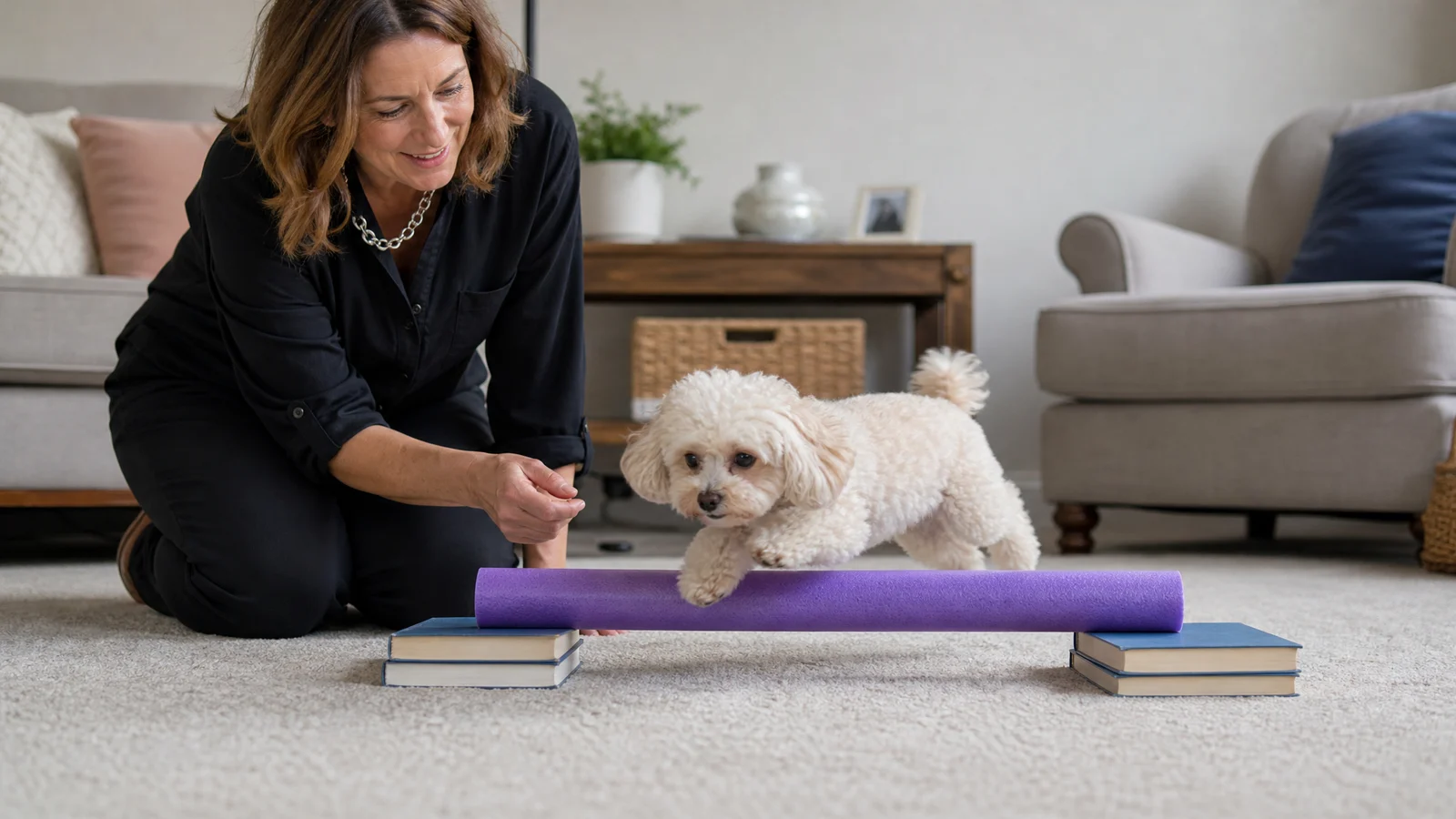
A Maltipoo does not need to clear anything to learn this trick. A pool noodle resting across two paperbacks is enough, and the whole lesson is the short trip over it: a small step, a soft landing and a treat waiting where the paws come down.
Small bodies make the setup matter more than a dog's enthusiasm, so the first question is whether your Maltipoo should start at all, and only then how. The hop is also a short game rather than a workout, and our Maltipoo exercise guide covers the daily balance of movement and brain work.
This guide moves from that readiness check to a low, forgiving setup, then a three-stage method with every step spelled out, the usual stalls and a few practical questions.
Why a Maltipoo Agility Jump Stays Small
Whether to start comes down to what a jump means here: a hop over a bar so low that your Maltipoo could step across it, which is the only version we teach. A small dog lands on small paws, so extra height asks more of the landing than it adds to the trick, which is why the bar here never needs to climb.
Both parent breeds do well in dog sports such as agility, so a Maltipoo may well enjoy the game. Here is what we tell every Maltipoo household: the aim is a tidy step over, not a leap.
Before any noodle comes out, look for three habits that show the setup will make sense to your dog. None of them needs a trick, only a few quiet minutes of watching.
- Your Maltipoo walks across a rug or mat on their own, without slipping or hurrying.
- They take treats gently and look back at you afterward instead of wandering off.
- They meet a new object on the floor with curiosity rather than alarm, sniffing it and then moving on.
Those habits matter, and so does the calendar. PDSA's agility advice is that dogs should not jump until they are fully grown, which is usually around a year to eighteen months, and agility does put a dog's body under pressure, especially the joints, heart and breathing. If your Maltipoo has any medical concern, it is best to talk it over with your vet before training starts.
A Pool Noodle Jump Built on Two Books
Once your vet agrees and your Maltipoo has finished growing, the equipment is almost embarrassingly simple. A pool noodle rests loose across two small stacks of paperbacks, so a bumped bar rolls away instead of tripping a paw, and nothing about it can turn into a big event.
Work on a rug with some grip or on carpet, with a few strides of clear floor before the noodle and plenty of room beyond it for the landing. Keep a handful of pea-sized, soft treats in a pocket, because a small dog finishes a big treat slowly and the moment you wanted to reward is long gone by then. Set the paperbacks within reach of where you sit or stand, because a quick reset after a bump keeps the lesson moving.
For stage one the noodle lies flat on the floor. You and your dog walk the line side by side, a little like passing through a doorway together.
Teaching the Hop in Three Small Stages
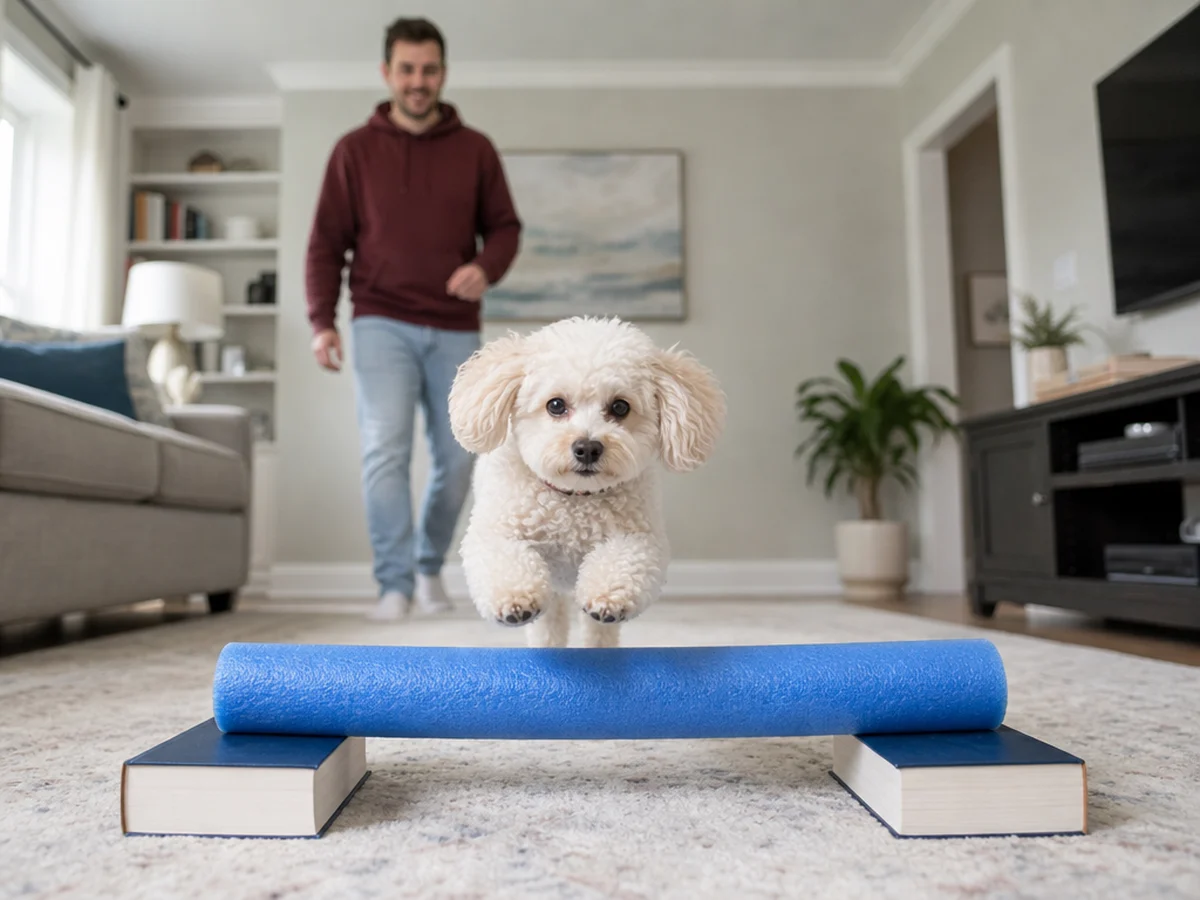
With the lane built, the order of the work matters more than its speed. Move on only when your Maltipoo does a stage smoothly several times in a row, and stay put when they do not. Each step has to be small enough that your dog has a good chance of getting it right, and a behavior that keeps falling apart is a sign of going too far too fast.
Walking Over the Noodle on the Floor
This first stage teaches one idea: crossing the noodle is a path that pays. Nothing about it asks for effort, which is why it works for a dog who has never seen the setup.
- Start with your Maltipoo beside you and the noodle lying on the floor a step or two ahead, and let them sniff it once.
- Hold a treat at nose height in your lure hand and walk forward over the noodle, so the treat leads your dog's nose and paws across.
- The moment the last paw crosses, say your marker word and give the treat low on the far side, right where the paws came down.
- Turn together and walk back over the noodle the same way, then pause for a breath before the next crossing.
- Repeat until your Maltipoo moves along the line without sniffing, stopping or swinging wide, several times in a row.
The stage feels too easy, and that is the point: a dog who cannot get it wrong learns the line quickly and starts watching your hand instead of the noodle. If your Maltipoo stops to inspect the noodle every time, bring the treat right up to its edge and pay for any step toward the far side before asking for the whole crossing.
Lifting the Noodle Just Off the Floor
Now the noodle rests on one paperback at each end, just high enough that a paw has to lift. Your Maltipoo walks the same line, and the only new thing is that small lift, so keep every other detail of stage one exactly as it was.
- Set one paperback under each end of the noodle and check that it sits loose and level, so a bump moves the noodle and not your dog.
- Walk the line with the lure at nose height, at the same pace as before, so the lift is the only thing that changed.
- Mark the instant all four paws are over and give the treat low on the far side, as in stage one.
- If the noodle gets bumped and rolls away, put it back without a word, so a bump never becomes an event.
- Stay at one paperback high. Once your Maltipoo crosses smoothly several times in a row, the setup is done and the next stage works on the signal.
A low noodle is plenty for a small dog, and a dog who knocks it off is only finding out that the lift is new. If your Maltipoo hesitates at the raised bar, lay the noodle flat for a crossing, pay well, then lift it again.
Teach a Maltipoo to Jump on Command
With the lift comfortable, the lesson changes from following food to listening for a word. Choose a short cue such as hop rather than up, so the word stays clear of greeting jumps, which our Maltipoo jumping on legs guide handles on their own.
- Walk the crossing with an empty lure hand held at nose height, keeping the treat in your other hand behind your back, so your dog learns to follow the hand shape and not the food.
- Mark the landing and deliver the treat low on the far side, just as before.
- Shrink the sweep: each time your Maltipoo crosses smoothly, make the hand motion a little smaller, until a short low point toward the far side is enough.
- Say your word once, just before your hand moves, so the word begins to predict the hand.
- When the word works with the hand, say it and wait a beat with your hand still. If your Maltipoo crosses, mark and pay generously, and if not, give the hand as before.
- Carry the game to a second room and then a different rug with the same noodle, and expect to give a little more help at first in each new place.
A word that arrives before the hand is the moment your dog starts listening instead of watching, which is why it comes once and early. If your Maltipoo only crosses when the hand moves, the pause came too soon, so give the hand a few more smooth crossings and then try the beat again.
Fixing a Stalled Jump Session
The fixes inside each stage cover the hiccups that belong to that step. Three problems can appear anywhere in the sequence, so they get their own section.
Going Around the Noodle: A Maltipoo who swings wide is choosing the easiest path, so make the straight line the easiest one. Start the lure directly over the middle, hold the treat just beyond the far edge, and when you can, lay the noodle across a hallway floor so there is no way around.
Rushing the treat. A dog who scrambles or bounds is chasing food rather than crossing a bar. Slow your lure and mark only a calm, balanced landing, so the treat follows the steady version.
When a session fizzles and your Maltipoo starts sniffing the floor or drifting toward the door, the lesson has outlasted their interest. Finish with one easy crossing, pick up the noodle and try again later. If a stall lasts for days, or a dog who crossed happily last week turns stiff or reluctant to step, pause the practice and mention it at your next regular vet visit.
What Comes Up While Your Dog Learns to Jump
Three practical choices sit outside the order of the stages, and each one changes what you buy, hold or say in the next session. None of them changes the stages, so the answers stay short.
Do I need a clicker to mark the hop?
Not at all, and with a noodle on the floor and treats in your hands, a spoken word is often easier to manage. A word such as yes does the same job as a training clicker, and either one pinpoints the exact moment your dog earns the reward.
What if my Maltipoo chews the noodle?
Take it away calmly, hand over a chew toy and keep the noodle out of reach between sessions. If your dog ever swallows a piece, call your vet. A light cardboard tube across the same paperbacks does the same job if the noodle becomes a toy.
What if my Maltipoo wanders off after the treat?
A far side that is more interesting than you are can win. Clear toys and other pets from the lane, and after the treat, step away and let your Maltipoo follow you back to the start before you begin the next crossing.
Let a Maltipoo's Landing Set the Height
Everything on this page leads to one small moment: four paws touching the rug again. A Maltipoo who lands softly and trots on to the treat has a bar at the right height, and a skid, a thump or a scramble means the setup asked for too much.
So let the landing make the height decision every time you play. When it turns noisy, lay the noodle flat for the rest of the session, and when it stays soft, leave everything exactly where it is. At your next session, start on the floor, pay for a quiet landing and let that, not the height of the noodle, be the measure of how far this trick goes.
 Puppy trainingAre Maltipoo Puppies Easy to Train?
 Exercise and jobsCan a Maltipoo Be a Service Dog?
 Training basicsHow Smart Is a Maltipoo for Training?