 Maltipoo
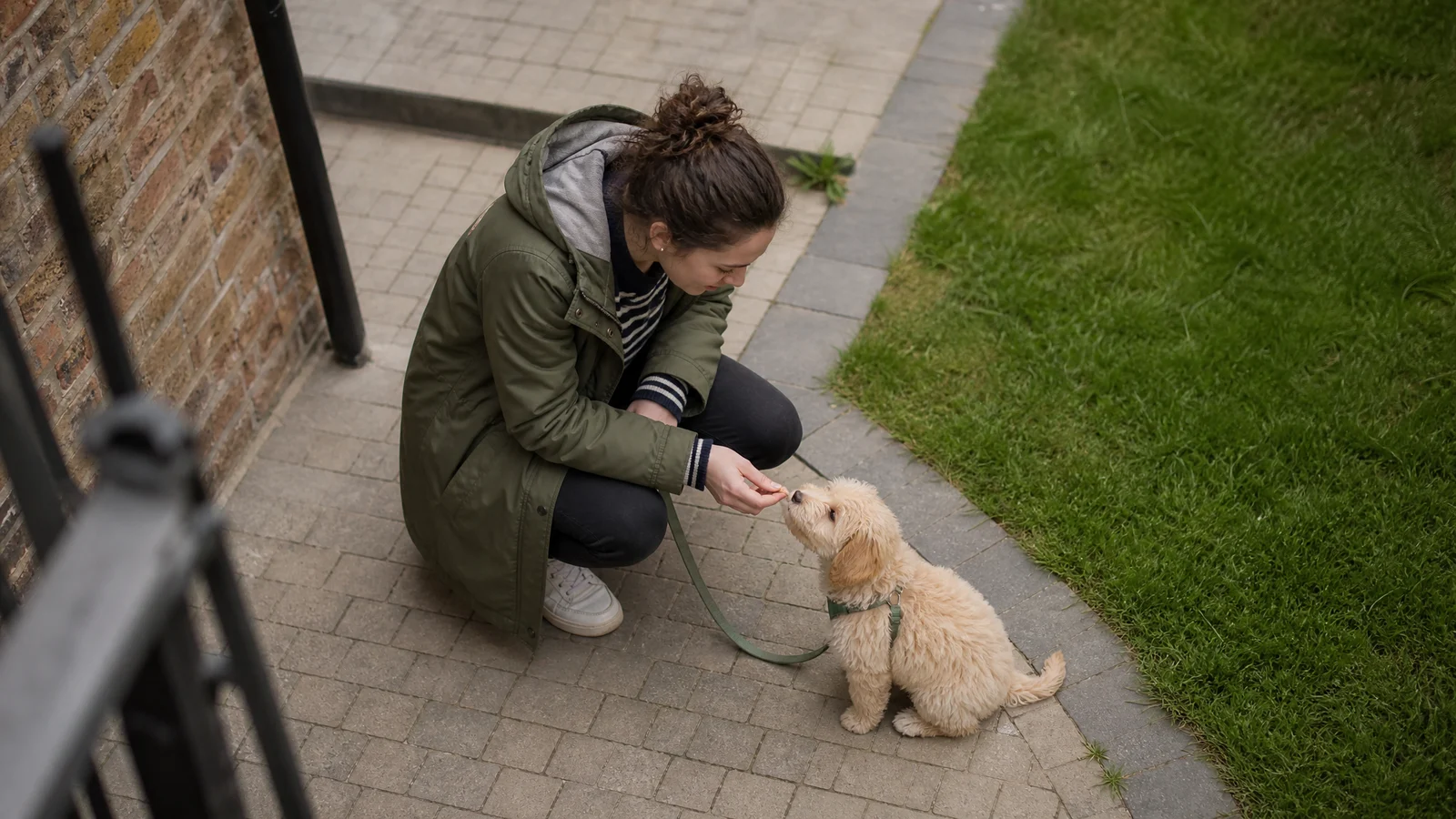
To potty train a Maltipoo puppy, pick one outdoor spot, reward within seconds of the puppy finishing there, and take them out on a tight clock. Expect reliable habits closer to 4 to 6 months than to a few weeks, with accidents most weeks until then and rare ones afterward.
The cross explains both halves of that advice. The Poodle side rates 5 of 5 for trainability and the Maltese side 3 of 5, and both parents are Toy Group dogs, so you get a quick learner with a very small bladder. Rewards land fast, but the routine has to be steady and small-scale. Results vary from dog to dog.
This article walks through each decision in the order you face it: the outdoor spot, grass versus pads, the reward, supervision between trips, the trip schedule and how to handle accidents. It closes with a plan for two weeks.
Choosing One Potty Training Spot Before Day One
Decide on the spot first, because every later choice leans on it. Pick a patch of ground close to the outside door that you can reach in rain and in the dark, and use only that patch while the habit forms. A toy-sized puppy has little warning between the urge and the accident, so a long walk to a far corner costs you trips. In an apartment, the nearest strip of grass beats a nicer park that takes a while to reach.
Weather and light deserve a vote here. Many Maltipoo owners find that rain, wet grass or darkness make a puppy refuse to go, and some puppies hold their poop until they are back inside, then go at once. If your spot floods or sits in shadow, choose a drier or better-lit patch. If the puppy still balks, leash-walk to the spot or walk small circles on a harness, and reward right there when it works.
Pair the spot with a cue word from the first trip. Say a short phrase such as go potty as the puppy starts to go, not before, so the words attach to the act. After enough repeats the phrase prompts the behavior, which helps on cold mornings and in unfamiliar places. Run a quick test before you commit:
- If you can carry the puppy there without hunting for shoes, the spot is close enough.
- If the surface turns to mud or puddles in rain, it is the wrong spot for the first weeks.
- If you cannot see the puppy at the spot after dark, add light or move the spot.
The choice: one patch near the door, kept dry and visible, with go potty as the cue.
Should a Maltipoo Puppy Use Grass or Pads?
Grass versus pads is the decision owners disagree about most, and Maltipoo households split too. Some owners found that removing pee pads cut accidents and helped the puppy learn outdoors. Others found that a pad preference, or a habit of mixing pad and outside, lingered for a long time. A few are content with a dog who uses both a mat and the yard, and that is a legitimate household choice if you make it on purpose.
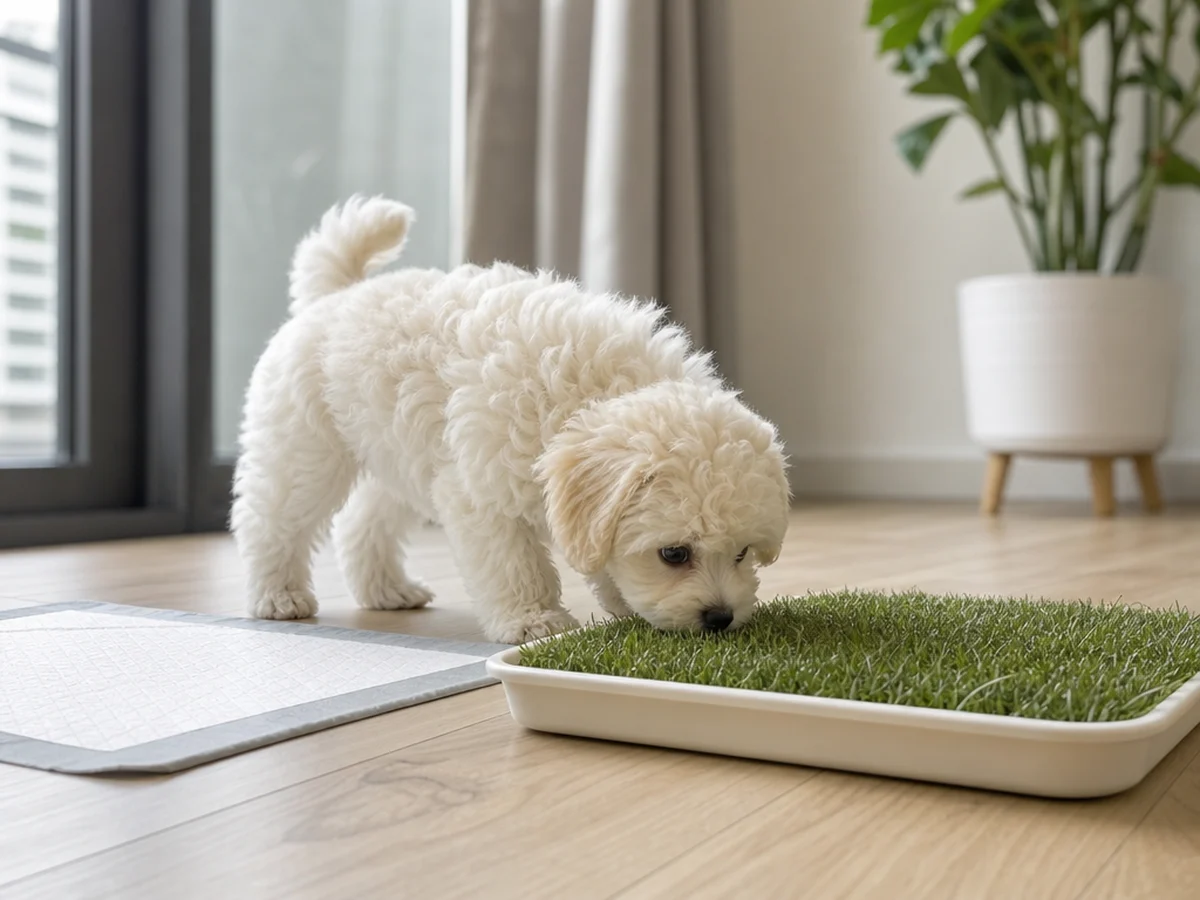
A common tip is to leave a pad down as a safety net while the puppy learns. If you want a dog who goes outside, that net often muddies the lesson, because the pad teaches that an indoor, absorbent surface is acceptable. Mostly trained dogs also tend to revisit soft spots such as carpet and rugs. So if you are home and can run the clock below, go grass only. If you work away, live high up or face truly bad weather, keep one pad in the pen as an exception.
Switching From Pads to Outdoors
Switching later is easier than people fear if you do it in order. If your puppy already uses a pad, move it closer to the door over several days, then outside, then remove it while keeping trips frequent. Some pad-reliant dogs learned the outdoors quickly once the pads were gone and trips came often. If accidents jump after a removal, you moved too fast, so put the pad back one step and hold there longer.
The choice: grass only, with a single pad in the pen as the exception for long gaps.
Which Reward Makes Potty Training Stick?
Treats, praise and play all work, but they are not interchangeable, and potty training depends on delivering the reward within seconds of finishing, at the spot. Treats win on both counts.
A small, soft, high-value treat can be handed over the instant the puppy finishes, and owners credit treats kept only for potty trips, because a food the puppy never gets elsewhere carries extra weight. Make it tiny enough to swallow at once, so the puppy is not still chewing when they should be learning.
Praise is the right partner, not the main reward. It is free and instant, but on its own it often fades into background noise for a young puppy. Say a marker word such as yes as they finish, give the treat, then add warm praise. Play is the bonus. It suits a Poodle side rated 5 of 5 for playfulness, but only after the potty is done, since play offered first teaches the puppy that dawdling keeps the fun coming.
The Poodle parent is people-oriented and eager to please when sessions are fun and consistent, while the Maltese parent has learned to get exactly what they want from their people. If your cross shows the second streak, pay for the potty and not for staring or whining at the door. For more on how this cross learns in general, see Maltipoo puppy trainability.
Teaching a Bell Signal
Many dogs eventually signal at the door or ring a bell, but treat it as a bonus and not a requirement. Touch the bell with the puppy's nose or paw just before each trip, say the marker, then open the door. Bell learning can take a couple of weeks, so keep the scheduled trips running while it develops. If the puppy rings for attention and does not go, still step out, but reward only an actual potty.
Fading Treats to Praise
Fade only after the habit is dry and boring. Once the puppy has gone to the spot reliably for a stretch of days, treat on most trips instead of all of them, then on the occasional trip, with praise every time. If accidents return, go back to a treat every time. Treat the fade like the schedule: if it brings a slip, step back and hold longer.
The choice: a treat at the spot as the main reward, with a marker word and praise on top, faded only after dry days stack up.
Crate, Pen, or Lap Between Potty Trips
Between trips, your puppy needs to be either watched or contained, and the right pick depends on what you are doing. Young puppies are not house trained and cannot be left loose on furniture without accidents. Many owners limit roaming space and widen it gradually as control builds.
Others tie accidents to being left alone or not being taken along, with some dogs using a pad or the hallway whenever the household is out. If accidents keep appearing when you are not looking, the space is too big or the gap between trips is too long.
The Crate
Use the crate for naps and sleep, since you can lift the puppy straight from the crate to the spot the moment they wake. Timing matters more than anything else here. A puppy crated beyond what they can hold will have an accident in there and learn nothing useful. If your puppy fusses, check whether they need to go before assuming they only want company.
The Exercise Pen
Use a pen when you are home but busy, or when you must step out for longer than one trip allows. A pen gives a small floor area so the puppy cannot slip off to a quiet corner. Put sleeping and play space in it, and if you work away, add the single pad from earlier. When several dry days pass, enlarge the area one room at a time instead of opening the whole house.
Tethered to You
When you are home and awake, keep the puppy attached to you with a light leash, or on your lap while you watch them. This is the strictest option and the fastest teacher, since you notice the sniffing and sudden wandering that come before an accident and can head for the spot. Never leave a tethered puppy unattended, and swap to the pen when you cannot look up.
The choice: tether or lap while you are awake and home, the pen when your attention is elsewhere, and the crate for sleep.
Setting a Maltipoo Potty Trip Clock
A tiny bladder means the clock runs fast, and the commitment for the first week is simple. For very young puppies, owners describe trips about every 30 minutes, then hourly, tapering slowly. Start there and treat hourly as the longest gap in week one.
Frequency is the one lever that works for every puppy, because it removes chances to practice indoors. Within 4-6 weeks puppies generally settle into a routine, though real reliability tends to come near six months, when their bodies can hold on better.
Layer triggers on top of the clock. These moments call for a trip regardless of what the timer says:
| Moment | Trip |
|---|---|
| Waking from a nap or the night | Straight to the spot, before play |
| Right after a meal | Immediately, since some dogs go within moments of eating |
| During or after drinking | Immediately, since some dogs go while drinking |
| After a burst of play | As soon as play stops |
| Before the crate or pen | Last thing before confinement |
Read the results with if-then checks. If accidents land between trips, add a trip just before the usual time of the slip. If every trip pays off for several days running, stretch the interval a little, never all at once. If a longer gap brings an accident, go back to the previous gap that worked, then hold it longer. If accidents happen only when no one is watching, the problem is supervision and not the puppy.
Owners who describe a timeline report weekly accidents until around 4 to 6 months and rare ones afterward, so a slip in week three is data and not failure.
The choice: a trip about every 30 minutes while awake plus every trigger in the table, with hourly as the ceiling for week one.
Potty Training Accidents Without Scolding or Fuss
How you react to accidents decides whether the next one happens in front of you or behind the sofa. If you catch one in progress, make a cheerful sound to pause the puppy, scoop them up, carry them to the spot and reward them if they finish there. If you find a puddle afterward, clean it and say nothing, because the puppy cannot link a puddle to something that happened minutes ago.
Keep your response calm and your routine steady. Because both parents are people-oriented companion dogs, a Maltipoo is likely to learn best from structure, routine and guidelines, and a cheerful interrupt followed by a reward in the right spot protects the trust everything else depends on. Treat each accident as information about the clock: check when the puppy last went out, ate or drank, then shorten the gap and take them out sooner next time.
Clean every accident the same way:
- Blot up as much as you can without pressing it deeper into the surface.
- Apply an enzyme cleaner and leave it to work as the label directs.
- Give carpet, rugs and other soft surfaces extra attention, since repeat spots are common there.
- Block access to the area until it is dry and odor-free.
- Ask what changed, such as a missed trip or too much freedom, and fix that first.
When a Trained Dog Slips Back
A dog who looks fully trained can drift into new accidents or a pad preference after a change. Owners point to a move, a vacation routine shift that lets the dog sleep anywhere, or a stomach upset as typical triggers. Some mostly trained dogs also keep returning to one spot, often on carpet or a rug. Treat it as a reset and not a failure.
Go back to scheduled trips, tighter supervision and the special treat for a while, and block off the favorite spot. Most dogs recover quickly because they already know what you want. Keep up regular vet visits through puppyhood, and mention any sudden change in how often your puppy needs to go, especially after a stomach upset.
The choice: a cheerful interrupt, a quiet cleanup and a return to the clock, with no scolding at any stage.
A Potty-Trained Maltipoo Comes From Two Steady Weeks
Staying the course beats adding tricks. Expect the result to land in the usual house-training range of 4-6 months, which shifts with size, age and earlier habits. A minority of owners report success within days or a week, and a few find it much slower than with other dogs. Dogs vary, so judge your puppy against their own last week and not someone else's.
That is also why the Poodle side's 5 of 5 trainability does not shortcut the process. Quick understanding does not give a toy-sized body more capacity. What this cross rewards is a small-scale, steady routine: same spot, same cue, same treat timing, trips on the clock. We have trained this breed for many years, and the plan that works is the dull one, repeated.
In week one, fix the spot and cue word, run the trip clock at about every 30 minutes while awake with hourly as the longest gap, and add every trigger from the table. Reward with the marker and a treat at the spot within seconds, and keep the puppy tethered, penned or crated between trips. Write down each trip and each accident.
In week two, if the last few days were dry, stretch intervals a little at a time. Move from a treat every time to most times and then to praise, and widen the play area one room at a time. Review your notes. If accidents cluster at one time of day, add a trip before it, and if a longer gap brings a slip, step back one gap.
Do not grade your puppy at the end of week two. A small, smart, affectionate cross finishes the job on a tiny body's timetable, and reliable habits usually arrive nearer 4 to 6 months. Keep paying for the right spot, keep the routine steady through changes, and your Maltipoo will get there.
 Training basicsTraining an Adult Maltipoo With Rewards
 Exercise and jobsTrick Training for Maltipoo Dogs at Home
 BehaviorQuieting a Maltipoo Who Barks at Every Visitor